
Mahdiya Erfani was born in Afghanistan, but today she says that her "home" is Lisbon, the city that gave her ‘safety in a way she had never experienced before."
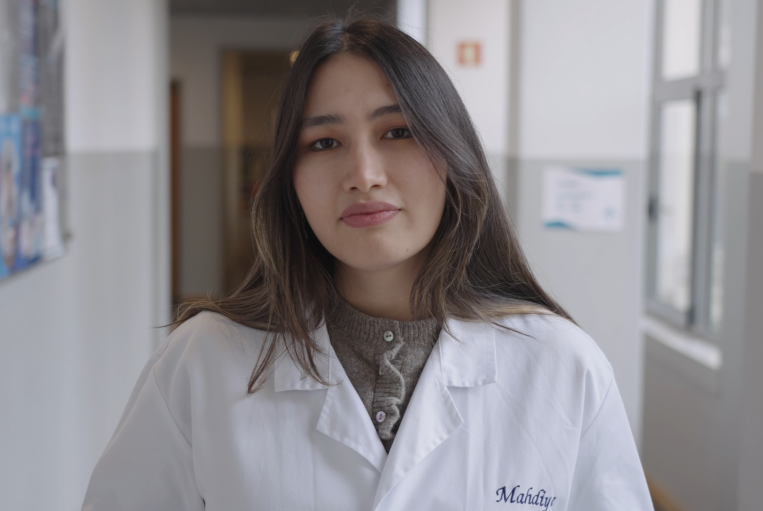
She arrived in Portugal in November 2021, "not only as a young woman in pursue of a career but a as a person in pursue of a safe and happy life" believing that "many opportunities" awaited her.
"The life of a refugee begins in uncertainty," but "but Portugal welcomed us with generosity," Mahdiya recalls. With a degree in Political Science and Public Administration from the American University of Afghanistan, the Afghan felt, however, that she had another calling: medicine. She followed it, enrolling at the Kabul Medical University where she studied until August 2021.
"When the Taliban took over, my education — like the future of countless Afghan women — was abruptly interrupted," says Mahdiya, who nevertheless did not give up.
After the evacuation and during the integration process, she learned about the integrated master's degree in medicine in English at Católica Medical School, to which she applied and was admitted, obtaining one of the university's scholarships dedicated to refugees.
"The scholarship, in particular, was a turning point. It allowed me to restart my medical education without the weight of overwhelming financial constraints." the student emphasises.
Regarding her career path and university, she highlights the innovative teaching methods, the experience of the lecturers and the problem-based learning system, which "has been transformative". "It is dynamic, intellectually stimulating, and closely mirrors real-world medical practice. For me, medicine is more than a profession; it is a bridge between science and humanity," reveals Mahdiya, who also wants to be involved in research, innovation, and global health policies.
"Católica taught me life lessons," sums up the future doctor, pointing out that, academically, it broadened her "ability to think critically, apply knowledge, and navigate complex cases" and, personally, developed her "resilience, adaptability, and a deeper understanding of cultural diversity and its value".
During the course, she has found the tools to deal with complexity, but also to act with precision and empathy. There have also been many memorable moments, such as anatomy classes, the first time she had a fluent medical conversation in Portuguese with a patient, lab work, and Christmas and New Year celebrations, where teachers and students celebrate the season with humorous songs about medical life in a "raw, kind, and full of joy".
"Católica has also become a platform for me to advocate for the rights of Afghan women, which have been eliminated under an extremist regime, and to promote the voices of vulnerable groups," Mahdiya adds.
Enchanted by Portugal's nature, the Atlantic Ocean and beaches, and knowledgeable about Portuguese cuisine, Lisbon's most secret corners and the language, Mahdiya says she has a "sense of belonging" and the ambition to "become a force for good".
"I want to reach a stage where I can give back — to Portuguese society, to my university, and to everyone who stood by me during the complex journey and those who did not summarize me to just a medical student and a refugee status holder," she sums up, adding that her dream is "to serve humanity through scientific innovation— to create solutions that genuinely improve lives. I also want to be a reliable resource for those in need, especially the women of Afghanistan."